♥♥♥

Zura
Writer, critic, philosopher, historian, linguist, artist... and whatever else slips in.Rapidly confounding reality with alternate timelines.Liminality is my oxygen; getting lost in rugged landscapes, forgotten places, and abandoned buildings filled with memories that have quietly given way to new ones. Solitude plays a central role in my identity -- not just as an escape from people, but as a condition in which I can think clearly, uninterrupted by exterior noise.Art, language, philosophy, psychology, and travel all serve the same purpose: they are different lenses through which I attempt to understand the world. Whether creating or consuming, I find meaning in the pursuit itself. Curiosity remains the constant thread running through my life -- a desire to divulge in different perspectives, and better understand the phenomenon of the human psyche.Most recent review: Begotten
< Language Journey >
I find language to not be merely a tool, but rather the rhythm of thought, the resound of culture, and the reticent fabric of human connection.My fascination with psychology fuels my love for words; meaning, comprehension, difference. For each language is a key to understanding not just how people speak, but how they think, feel, and dream.Language becomes the gateway to unlocking new cultures, meeting new people, and self-discovery. I have a list of ~100 languages I wish to learn (a simple task, right?), and will make this a lifelong journey. It gives meaning to my life, and that's all I seek in this pitifully ordinary world.I primarily learn languages through books, and other forms of media; entrenching myself in the culture. I've also made my own dictionary to help me learn words, as well as understand etymological similarities and differences between languages. I avoid most apps as they are simply businesses made with the sole intent of looting your pockets for gold, rather than actually help you learn a language.Up till the age of ~14, I only spoke 2 languages. My sudden interest can be attributed to my newfound fascination with psychology and a deeper desire to understand the world and the people in it. That said, my writing and reading skills are far stronger than my speaking skills in virtually every language (some exceptions...), but I don't reject speaking any more than I struggle finding use for it (since I'm highly antisocial). The only time I actually need to speak is when travelling, but even then it's rarely more than a few phrases. To fill the gaps, I mostly do shadowing and practice on my own.
Language Progress
🇬🇧 English: C2
🇳🇴 Norwegian: N
🇪🇸 Spanish: C1
🇧🇷 Portuguese: C1
🇷🇴 Romanian: C1
🇷🇺 Russian: C1
🇩🇪 German: C1
🇫🇷 French: C1
🇮🇹 Italian: C1
🇧🇬 Bulgarian: B2
🇳🇱 Dutch: B2
🇺🇦 Ukrainian: B2
🇨🇿 Czech: B2
🇪🇸 Catalan: B2
🇭🇷 Croatian: B1
🇵🇱 Polish: B1
🇦🇱 Albanian: B1
🇯🇵 Japanese: B1 (JLPT N3)
🇮🇩 Indonesian: B1
🇰🇷 Korean: B1
🇨🇳 Mandarin Chinese: A2 (HSK 2)
🇬🇪 Georgian: A2 (Current obsession)
🇬🇷 Greek: A2
🇻🇦 Latin: A2
🇱🇻 Latvian: A2
🇱🇹 Lithuanian: A2
🇸🇦 Modern Standard Arabic: A2
🇪🇬 Egyptian Arabic: A2
🇹🇷 Turkish: A2
🇫🇮 Finnish: A2
🇭🇺 Hungarian: A2
🇻🇳 Vietnamese: A2
🇪🇪 Estonian: A2
🇦🇲 Armenian: A2
🇹🇿 Swahili: A1
🇮🇷 Persian: A1
🇮🇳 Hindi: A1
🇹🇭 Thai: A1
🇲🇲 Burmese: A1
Note that I don't take tests or get certificates at all, because I consider fluency to be fluid and uncapturable through such means. Instead, my assessments are simply an estimate of my progress. I don't obsess over perfection or "sounding like a native speaker". It's just not realistic to me considering the amount of languages I want to learn, so instead I simply enjoy the journey and derive happiness from seeing my progress in real time.I also know 13 writing systems in total, so I'm quite illiterate, hehe.
To Learn
Abkhaz, Adyghe, Aramaic, Amharic, Ancient Greek, Assamese, Avar, Aymara, Basque, Bengali, Cantonese, Classical Chinese, Chechen, Chuvash, Guarani, Gujarati, Hausa, Hebrew, Hokkien, Igbo, Irish, Icelandic, Javanese, Kalmyk, Kannada, Kazakh, Khmer, Kurdish, Malagasy, Malayalam, Marathi, Meadow Mari, Mongolian, Nahuatl, Navajo, Odia, Oromo, Ossetian, Pashto, Punjabi, Quechua, Sanskrit, Santali, Scottish Gaelic, Sinhala, Somali, Swiss German, Tagalog, Tamil, Tatar, Telugu, Tibetan, Tigrinya, Udmurt, Uzbek, Welsh, Wolof, Yakut, Yucatec Maya, Yoruba, Zulu.Next in line:
Tamil, Bengali, Hebrew, Tagalog.I also aim to learn to understand languages that are mutually intelligible with one another (e.g., Tatar and Bashkir), but in such cases, I'll only focus on one and rather fill in the gaps of the other through exposure.
2026 Goals
🇯🇵 Japanese: B1 -> B2 # Vocabulary wise fluent; improving my reading skills.
🇦🇱 Albanian: B1 -> B2 # Picking up fast -- small and logical lexicon.
🇭🇷 Croatian: B1 -> B2 # Don't need to study this one.
🇨🇳 Mandarin Chinese: A2 -> B1 # More focus on reading.
🇹🇷 Turkish: A2 -> B1 # Logical and simple.
🇪🇬 Egyptian Arabic: A2 -> B1 # Easy, but few written resources.
🇸🇦 Modern Standard Arabic: A2 -> B1 # Complex, but logical; making fast progress.
🇻🇳 Vietnamese: A2 -> B1 # Will need a lot of listening practice.
🇹🇭 Thai: A1 -> B1 # Script feels a bit daunting.
🇲🇲 Burmese: A1 -> B1 # This one feels the hardest because of poor resources (Literally no way to learn this at a decent pace without AI...). More complex than anticipated. Similar to Japanese in many respects. Daunting script.
🇮🇳 Hindi: A1 -> B1 # Introduction to India. Reasonable difficulty.
🇫🇮 Finnish: A2 -> B1 # Picking up at a decent pace.
🇭🇺 Hungarian: A2 -> B1 # Complex, but well-documented.
🇪🇪 Estonian: A2 -> B1 # Feels like Finnish, but easier.
🇱🇻 Latvian: A2 -> B1 # Feels like Lithuanian, but easier.
🇱🇹 Lithuanian: A2 -> B1 # Complex and poorly documented. Will only focus on vocabulary.
🇬🇪 Georgian: A1 -> B1 # One of the most complex languages I'm learning.
Current focus: Georgian (main), Albanian, Armenian, Persian, Catalan (occasionally).
The above resemble suggestions more than expectations. I absolutely don't expect to achieve it all.My approach in 2026 so far has been to take a different direction; switching to AI-powered subtitles through movies and anime. By far the most effective method that I've discovered. Though, the accuracy depends on the clearness of the original subtitles (through Mandarin usually works) and content in general. I'm also specifically focusing on languages with fewer resources.I already play so many games that only have the same 3 Asian and 4-5 European languages available, so I'd set priorities in order to not end up with feeling that games become "entertainment" more than a mix between it and studying.By 2027, I'd like to get more time for the Indo-Aryan group and start with Celtic languages. Oh, and other Caucasian languages... since those will take forever to learn.
Favourite Languages
It's difficult to create a definitive list of my favourite languages, as each one holds a unique appeal for different reasons. That said, I tend to gravitate towards languages that are more distinct from my native tongue, particularly in terms of pronunciation, vocabulary, and structure. I’m not particularly drawn to simplicity in languages like Indonesian (it just feels ultra minimalist, honestly). While I firmly believe that the primary purpose of a language is communication, I appreciate different grammatical aspects that enhance and make the experience more unique. With that in mind, here are the languages I hold in the highest regard:
🇯🇵 Japanese
🇻🇦 Latin
🇰🇷 Korean
🇮🇷 Persian
🇫🇮 Finnish
🇭🇺 Hungarian
🇫🇷 French
🇬🇧 English
🇹🇷 Turkish
🇬🇷 Greek
🇬🇪 Georgian
However, everything is subject to review, as simply being exposed to a language more influences my liking to it.
< Music Journey >
Albeit I'm rather novice to musicianship as a whole, I'm fairly confident it will be an almost central part of my future identity.I'd say I'm more so interested in songwriting and singing than just outright instruments, though. I suppose because language appeals to me more than just sounds alone. That said, I'm very interested in learning more "exotic" instruments -- essentially composing more experimental songs in tandem with experimental aesthetics and fashion.Voice: Intermediate.
Piano: Beginner.
Guitar: Beginner.
Drums: Beginner.Want to learn:
Shakuhachi, Guqin, Duduk, Kaval, Panduri, Bansuri, Harp, Violin, Nyckelharpa, Flute, Sho, Sarangi, Hurdy-Gurdy.
< Travel Journey >
I'm very enthusiastic about travelling, and I've so far been to 15 different countries; Norway (9/15), Sweden (2/21), Denmark (1/5), England (1/9), France (1/18), Spain (3/17), Poland (1/16), Hungary (1/19), Romania (5/41), Moldova (4/32), North Macedonia (8/8), Kosovo (3/7), Albania (10/12), Latvia (3/43), and Turkey (1/81).(The parentheses refer to number of first-level administrative regions I've visited)
I don’t chase a number or a destination; I simply follow where the winds of adventure guide me, trusting the path to unfold with every step.I'm a bit of a completionist, and enjoy going to unknown corners of the world just to witness natural beauty and historical remains.I find solace in the quiet charm of smaller cities, where nature's grace meets architectural beauty, rather than the constant pulse of bustling metropolises. I grew up in the countryside, where the melody of birdsong, the hum of cicadas, and the scent of flowers linger in the air, while the earth awakens with the fragrance of rain-touched soil.✨ My favourite cities I've visited are: Budapest, Riga, Krakow, and Stockholm.In addition, I've lived in Romania for 4¼ months, North Macedonia for 1¼ months, and Latvia for 2 weeks.
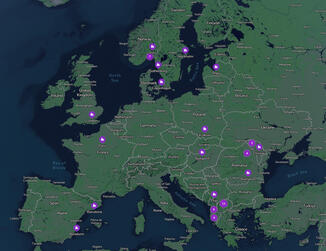
2026 Goals
🇱🇻 Latvia
♥ 🇬🇪 ♥ Georgia (Moving, woohoo)
Will start travelling Asia in 2027. At the moment I'm primarily interested in North Africa, South & South East Asia.
< Rating Philosophy & Principles >
I'm focusing on a very polymathic approach to art in general; consuming as much as I can in every imaginable medium and subsequently write reviews. As such, it's also important that I highlight exactly what I look after and value.Writing & Narrative:
I treat all works as systems that generate meaning, but distinguish between narrative and non-narrative works. Narrative works generate meaning through progression and recontextualisation over time, while non-narrative works generate meaning through structural compression, interpretive expansion, and cross-domain applicability (e.g., in real life). In both cases, value depends on whether the structure actively produces new interpretive states rather than merely restating itself.Above all, I prioritise media underpinned by consummate writing. Works should be multi-layered and/or genuinely compelling. They should also generally offer insight, pose thought-provoking questions, and retain their fascination when approached from different angles. The exception is when the narrative is intentionally fragmented; experimental and/or communicated through e.g., atmosphere or tone. Narrative quality, however, isn't the single deciding factor -- as I'm also likely to enjoy a work with a simple story, but e.g., visual, immersive, interactive, or auditory mastery. Yet no matter how innovative, experimental or original a work is, if the execution is just not there, it will lose significant points. Lack of originality is also a direct demerit if the work borrows too much from already existing works (e.g., Evangelion "clones") while lacking both the execution and innovation to make it stand out on its own. On the other hand, works existing merely as entertainment, spectacle, or shallow amusement will score relatively poorly. Quality also has to be consistent throughout the runtime."Writing quality" is a composite of narrative structure, thematic depth, dialogue, and stylistic execution, weighted differently depending on their role in the work. My central focus is generative depth: how a work produces meaning through structure, experience, and recontextualisation over time. This includes interpretive depth (thematic and philosophical layering), but also experiential and ethical depth, where meaning is produced through affect, discomfort, and sustained perceptual or moral pressure rather than narrative elaboration alone. Some works prioritise affective or experiential compression over narrative or thematic expansion. In these cases, value is derived from the intensity and coherence of the experience itself rather than from accumulated interpretive structure. I evaluate whether this experiential logic remains controlled and purposeful, rather than whether it produces traditional narrative payoff.Regardless of medium, genre, theme, or setting, the most crucial element is the work’s underlying generative architecture -- how its components are organised to produce meaning over time. I tend to prioritise multi-layered narrative structure, thematic depth, long-term interpretative potential (works retaining meaning decades later). I prefer genre mastery when ambiguity expands indefinitely rather than being constrained to something that gets solved at the end or when the main "puzzle" is solved. That said, I dislike overly opaque works where I feel that my cognitive investment goes nowhere. Pacing is also especially important; some works are well-written, but they progress at a pace that renders the work too boring to warrant active attention. Fillers, side quests, etc -- anything that distracts from the main narrative while also providing a clearly inferior experience, heavily detract from the experience (quantity is also important). While I have a slight preference for open ambiguity and unconventional narrative structures to leave room for interpretation, clarity and highly linear structures can be equally potent when used appropriately and executed masterfully.Additionally, works are penalised when morally or ethically charged behaviour is consistently "fetishised" without narrative interrogation or consequence unless contextually relevant in a way that supports what the narrative is attempting to frame (e.g., as a structural principle). The same applies when characters are reduced down to gaze-oriented (e.g., male/female) presentation in a sense that disrupts and/or replaces the flow and tone of the narrative with sensory gratification (fanservice).I penalise documentaries/biographical works that deliberately soften, reframe, and/or leave out crucial and relevant details of their subject in order to construct a controlled or reputation-preserving narrative.I don't believe that poor execution can be justified by the author's intent. If the audience's experience falls short, the work itself has failed. I mostly agree with Chekhov's Gun, but I believe elements that are not used should be explained through the narrative (either directly or indirectly). The big issue for me is when important aspects are straight up rejected later on (as it clashes with my expectations -- payoff is only important when the user expects it due to how the narrative is framed). That said, red herrings are acceptable in relevant narratives where they mislead in a way that still feels "fair", rather than information obfuscation, randomness, or to deliberately mislead. I tend to treat the addition of small and "trivial" details as good writing, especially if it could say something about the scene/character it's related to (unless it doesn't match the tone of what's happening). Structurally predictable character elimination is heavily penalised, since it removes uncertainty regarding the narrative. I don't dislike predictability in itself; I dislike when it's based on learnable pattern recognition. I'm also not a source material purist -- it's actually more interesting to me if the work adapts and changes aspects to make it more fit for its medium, since I'd rather have slightly different works that can be appreciated for different reasons, rather than almost identical works isolated between different mediums. The exception is when the adaptation becomes compressed and rushed to the point of obfuscating meaning and integral elements. If the source material (or even the adaptation) feels like the superior experience, then that will indirectly penalise the other work.Characters:
Flat, melodramatic, or cliché and stereotypical characters significantly diminish a work's merit. Similarly, female characters must be well-written and multifaceted, avoiding submissiveness, objectification, and/or one-dimensionality, unless thematically essential, critically explored, and/or subversion is intentional. I do not equate character flaws, emotional instability, or exaggerations as depth unless they are explicitly explored or structurally meaningful within the work itself (e.g., an aggressive character should ideally have their flaw be explored). On the other hand, I explicitly dislike perfect characters (e.g., mary/gary stus, such as unrealistic child prodigies). Repetitive emotional expression that does not generate narrative or thematic development quickly becomes "noise", rather than complexity (e.g., whining). Character depth and internal consistency are more important than likeability -- even morally questionable characters can feel alive if they are complex and coherent. A poorly written one does not. I don't need moral justifications as to why characters act as they do; just structural justification -- there needs to be "meaning". Similarly, dialogue quality is also very important to me in narrative works, and I'll often give extra points just due to dialogue alone. Works with no dialogue and/or characters (in primarily narratively driven mediums) will naturally struggle under my framework.Structure, Budget & Philosophy:
To me, repetition is generally a negative (especially when done ad nauseam, e.g., "grinding") unless it clearly serves the narrative, enhances the thematic experience, or is repeated in alternate structural states that feel different from one another. Slow burns are welcome, but only when it draws me in from the outset and/or warrants active attention (e.g., gradual yet meaningful and/or necessary build-up). Conversely, fast paced works will be penalised if the pacing neglects crucial narrative aspects in favour of keeping your attention. "Boring" isn't a word you'll hear me use a lot; because I reserve this for actually poorly made works -- where the structure isn't transformed in any meaningful way (e.g., 4-minute walking scenes where not even the camera angle changes). Works relying on extreme delayed gratification (e.g., making one wait hundreds of episodes before it gets interesting) score lower.I value both emotional restraint and emotional intensity, while manipulative melodrama is a strong negative. As such, emotional impact must feel earned and consistent with the work’s internal logic. Philosophical ideas matter only if the structure can carry them effectively. Similarly, I disagree with works whose own philosophy is contradicted during its runtime and/or through its creation. That said, I almost always separate art from the artist, unless the art is related directly to the "controversy" itself. Emotional resonance is not a primary criterion, but it can still influence interpretation (and often does).High production values are appreciated, but they do not compensate for weak writing -- even low-budget works can be highly regarded if they demonstrate clear effort, sincerity, and a genuine commitment to the story. In an ideal work, strong writing and strong production should elevate each other.I value media that challenges norms and questions hegemonic perspectives. I am also critical of media that normalises meat consumption (or any animal abuse, really) in scenes unrelated to the narrative, but this is a minor demerit, and not a decisive flaw. Works that provoke meaningful challenges to perceptions or worldviews receive a slightly higher rating.In terms of aesthetics, I'm clearly biased towards gothic, liminal, historical, and fractured worlds/narratives -- but I do and can appreciate a wide variety of different atmospheres and settings. But I will score a work with an overused setting less leniently if it fails to expand on what hasn't already been exhausted through other works (e.g., high schools and medieval fantasy kingdoms). Atmosphere alone is not enough to inflate the score unless it also produces layered meaning. Tonal consistency is also important to me, unless the work manages to masterfully combine them. If a work doesn't align with my initial aesthetic judgement, I'll typically set it aside for later consumption. The same applies to post-consumption where my initial aesthetic expectations weren't met, but it's clear to me that e.g., the writing is of high quality.Similarly, certain premises like being stuck in another world, death games, power fantasies, etc, fail to impress me and are less likely to score higher unless they have excellent and original aspects. I also don't care for most popular sports, so documentaries or narratives centred around them may have a harder time impressing me, even if they are well made. That said, I tend to find "niche" and/or less conventional sports a lot more interesting.Comedy:
I prefer comedy that is abstract, dark, absurd, clever, ridiculous, or over-the-top. On the other hand, safe, accessibility-driven humour and laugh-track sitcoms generally do not appeal to me (exceptions exist). Comedy is judged by creativity and commitment, not mass appeal. That said, I do not consider it to be a proper substitute for narrative and/or philosophical depth; I much prefer works that use comedy to leverage it, rather than as an excuse to detach itself from exterior elements.Rating Scale:
6.0/10 - Anything below this score is ultimately insignificant and disposable. Ranges from small to major issues in almost all departments (good production qualities don't matter). Not even worth contemplating about these.
6.5/10 - Quite decent; excels at some aspects and is held back by others. Not rewatch worthy, but I might frequently acknowledge that they had some good ideas.
7/10 - Good, competently made with clear flaws. These are the highest contenders for "maybe rewatch worthy" -- some of these could genuinely end up with a higher score as my taste matures.
7.5/10 - Very good, but balanced works; strong in one or more dimensions. These may be works that excel at their specific genre, but are thin in other areas of my framework -- or works that are e.g., philosophically dense, yet structurally incomplete. The difference between this and the previous category can often be as minimal as e.g., more aesthetic appeal, better dialogue, and/or genre preferences. Rewatch worthy, but not to a high degree.
8/10+ - This is the threshold for entering my overall favourites. Excellent works. Flaws are present, but not as obvious and detrimental.
8.5/10 - Excel in most aspects. Often more creative, experimental, and/or better executed than others.
9-9.7/10 - Incredible works, sometimes "masterpieces" that perhaps were held back just by a small issue (e.g., less aesthetic appeal).
9.8-10/10 - Timeless, almost perfect masterpieces that excel in every department. Often reserved to works in the single digit. These are the works I put on a high pedestal and compare everything else against.Non-narrative works are not evaluated on narrative criteria. Absence of story or characters is neutral, not negative. Non-narrative works are evaluated on epistemic and conceptual generativity, structural insight, and interpretive expansion. Non-fiction and argumentative works are not inherently lower-value than narrative works. They are evaluated on the same principle of generativity, but expressed through conceptual rather than temporal structure. A strong argumentative should ideally produce interpretive instability, competing explanatory frameworks, or unresolved theoretical tensions, rather than single-resolution clarity. Works may be structured around a single central concept if that concept generates internal dialectical tension, recursive reinterpretation, or competing sub-models. Conceptual singularity is not a flaw if it produces structural depth through contradiction or layered explanation.Writing quality is the dominant weighting factor in my ratings. Strong visuals or sound design alone do not tend significantly raise a score. If story and character quality are mid-tier (e.g., 6-7), the overall rating will usually remain at max around ~7.0 unless supported by strong structural and thematic coherence.Criteria in order of importance:
Story, characters, philosophy, sensory innovation/mastery, immersion.My ratings change constantly; I actively go over them and adjust them in accordance to how my standards change. It's important that I genuinely feel that I've "absorbed" all there is to know about a work before giving it a mentally "unchangeable" note. I use different sources in order to get an impression of what I would think of different works, but I try to avoid directly focusing on score and/or reviews in order to avoid direct bias.Overall (TLDR):
While many of my favourites are philosophical, experimental, or unorthodox, this is not a prerequisite. My ratings may seem harsh, but they're not pedantic. They're based not only on the context of its production but also on how well it holds up in the present day. Classic status or historical significance does not exempt works from criticism. A work can be conventional and still score highly if it is well written or excels through sensory innovation, experimentation, and/or mastery. Ultimately, what matters to me is not genre, popularity, influence, or budget, but the quality of expression and the depth of the writing.
< Future Vision >
I'm fascinated by the idea of creating a v-kei band and sing in lesser known languages. Especially because music (or media in general) is a massive factor as to which language we choose to learn. It's such a shame how, really, there are just a few "massive" languages that get all the appreciation -- and the rest just become forgotten; Persian, Georgian, Armenian, Bengali, Tamil, and many more. A lot of languages are big enough to potentially have a lot of media, but the media is often low quality as the country(s) suffer from brain drain due to e.g., economic issues. I'd love to give them the spotlight and encourage language preservation as well as the creation of more resources so that the selection of languages that feel "accessible to learn" enlarges.Here the problem becomes portability; since I travel so much, physical possessions become redundant -- so I'll have to postpone this until I have a stable home where I can store my instruments.I'm interested in creating video games, too. Especially PSX-styled dreamlike horror (or psychological horror in general), as well as large-scale dark fantasy open-world games. One of my ideas is to use a real world language as a fundamental part of the story, and base the mystery around deciphering the language -- which would essentially teach you it, but it wouldn't feel like studying.I like doing things on my own to the extent possible, as it signals a sense of independence, as well as mastery. So, what remains is to learn everything that I will need on my own. The tools are often readily available anyway; it all boils down to motivation -- except for PC building due to the mere inconvenience of having long hair and having one's hair obfuscated as a result. I'm frankly not very interested in electronics in the first place.
< Miscellaneous >
I first got into psychology and philosophy when I was around ~14, and I quickly got indulged into it. It sparked a curiosity that led me to explore and analyse the world around me in new ways.
I've dreamed in different languages only a few times. Most of the time, my dreams don't have dialogue. They're also based around extremely abstract places, but I often recognise them as "real life locations" (but where, who knows?).
I love fashion. Especially v-kei (Visual Kei), Lolita, Mori-kei, and gothic/alternative styles. I enjoy changing up my style once in a while, and trying new combinations.
I live extremely frugally, as I despise materialism and have learnt to be happy with very little. I'd gladly live in a small akiya in the forest.
I'm vegetarian, living on a mostly plant-based diet. My principle is to do as little harm as possible in every domain of life, rather than outright abstinence -- as the latter creates immense discomfort due to my nomadic lifestyle; lack of regional availability. That said, I'm trying as hard as I can to avoid giving any money to the dairy industry -- they're some of the worst motherfuckers on this planet. I could rant about the horrific treatment of animals all day, but I won't -- just go watch this instead: Dominion.